
18. The AI-First Leader: Mastering the Strategic and Ethical Imperatives
Now we have looked at all 17 articles, below is a summary and the key points from the last week of posts.
The integration of Artificial Intelligence (AI) and automation is not merely optimizing business processes; it is fundamentally reshaping the definition of effective leadership. The consensus across current research is clear: AI has shifted from being a technological experiment to a strategic necessity. Leaders who delay AI integration risk organisational obsolescence in an increasingly automated and data-driven world. The influence of AI extends across all organisational levels, augmenting capabilities, transforming power dynamics, and simultaneously introducing critical ethical and operational challenges.
AI enhances leadership effectiveness by providing data-driven insights and automating routine tasks (such as organizing, scheduling, and transient data decisions). This shift frees human leaders to focus on higher-level responsibilities like strategic thinking, innovation, and overcoming the human-technology gap. The literature identifies key AI-driven skills required for top managers, including data-driven decision-making, agility, and emotional/social intelligence. However, the power of AI is a “double-edged sword”, necessitating careful ethical and strategic governance to mitigate associated risks.
Major themes concerning AI’s impact on leadership include:
• The Paradigm Shift to Hybrid Leadership: Traditional leadership theories must evolve into hybrid models that fuse AI’s analytical strengths with indispensable human qualities. Leadership is redefined as an ethical and strategic mediator in the Human Intelligence (HI)–Artificial Intelligence (AI) relationship.
• The Ethical Imperative: AI adoption introduces significant risks like algorithmic bias (e.g., in recruiting tools), data privacy concerns, and the potential erosion of human-centric qualities like empathy and moral judgment. Ethical leadership requires navigating these dilemmas by ensuring transparency, fairness, and accountability.
• The Role of AI as Co-Leader/Substituter: AI is progressing from a mere tool (NOW) to a proactive advisory/support role (NEW), and potentially substituting core managerial functions in the future (NEXT). AI is seen as an effective support for cognitive functions like conceptual skills, but it lacks authentic emotional responses and empathy. The role of human leaders is transforming into a proactive advisory support role, which could potentially substitute human leadership in the future.
• The Need for New Capabilities (DMC): Effective leadership in the AI environment requires leaders to possess Dynamic Managerial Capabilities (DMCs), specifically technical capability (AI knowledge and data utilization), adaptive capability (problem-solving using data-driven rationality), and transformational capability (managing organizational change and uncertainty).
• Risk of Automation Saturation: The potential for excessive AI-enabled process automation can diminish leadership effectiveness and project performance if crucial human oversight is lost. AI decision-making often works on data-driven rationality, which may compromise ethical standards if not mediated by human judgment.
——————————————————————————–
As a Leader, What You Must Do Now
To successfully navigate the AI era and maintain strategic relevance, leaders must move beyond theoretical understanding to practical, critical action:
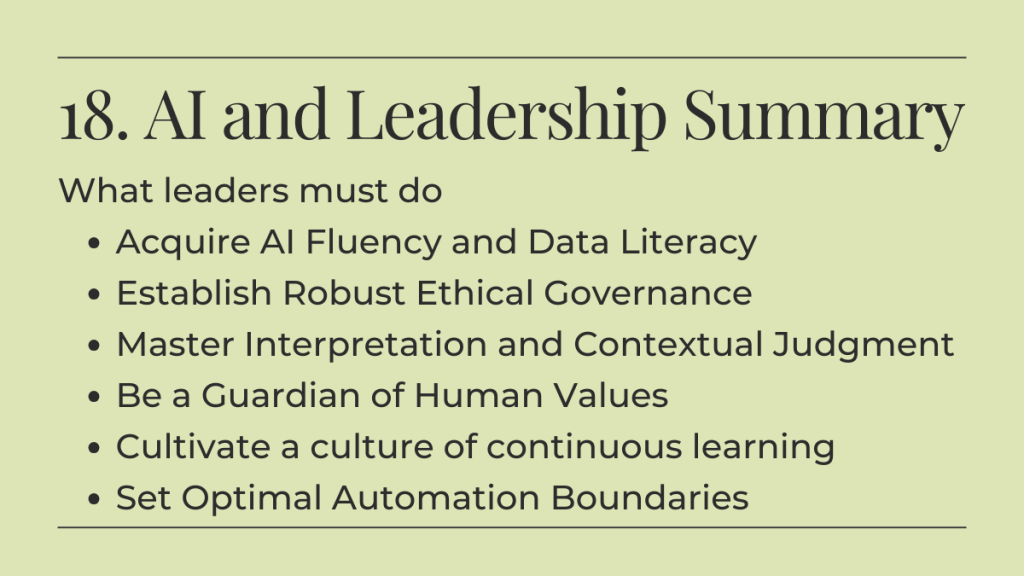
• Acquire AI Fluency and Data Literacy: You must gain fluency in foundational concepts like Machine Learning (ML) essentials and generative models. You need the ability to analyze data critically and accurately to translate AI-generated insights into effective strategic action.
• Establish Robust Ethical Governance: Given the “serious risks”, establish and adhere to stringent ethical guidelines, accountability, and transparency mechanisms. You must proactively mitigate algorithmic bias (e.g., in recruitment) and address data privacy concerns.
• Master Interpretation and Contextual Judgment: Since AI fails to factor in ethical and social issues, your primary responsibility shifts to being the interpreter of AI outcomes, putting algorithmic outputs into real-world context through human judgment and reasoning.
• Be a Guardian of Human Values: You must safeguard the integrity of human interactions and resist the lure of stronger machines. Leaders are needed to fill human gaps left by automation, focusing on emotional intelligence, empathy, and ensuring technology enhances, rather than replaces, human agency.
• Develop Adaptive and Transformational Capabilities: Cultivate a culture of continuous learning and possess the agility to respond quickly to technological change. You must manage uncertainty and drive fundamental organizational change (Transformational Capability) while effectively communicating the vision of AI integration to employees to build trust and prevent anxiety.
• Set Optimal Automation Boundaries: Critically determine where technology provides genuine enhancement and where excessive automation risks compromising human oversight and strategic flexibility. This involves restructuring roles to leverage AI, defining where people are “taken out of the loop,” and where they remain involved.
The future of leadership is not in ceding authority to algorithms but in mastering the collaborative art of leading both humans and intelligent machines.

