
13. Digital Leadership: Dynamic Managerial Capability Perspective
Part 13 of 17 of a research-based series exploring AI’s impact on leadership This post summarises the article Digital Leadership: Towards a Dynamic Managerial Capability Perspective of Artificial Intelligence-Driven Leader Capabilities by Hossain et al. (2025)
Are traditional managerial capabilities obsolete, or are they simply being amplified and redefined by AI? This research, viewing AI-driven capabilities through the Dynamic Managerial Capabilities (DMC) lens, finds that digital leaders require technical, adaptive, and transformational capabilities to succeed in AI environments. The key finding is that AI-driven capability enhances human intelligence by stimulating reasoning and enabling collaborative human-machine behavior, thereby overcoming cognitive limitations. Specifically, transformational leaders are well-positioned to operationalize these capabilities, fostering creativity, adaptability, and managing employee fears about job security.
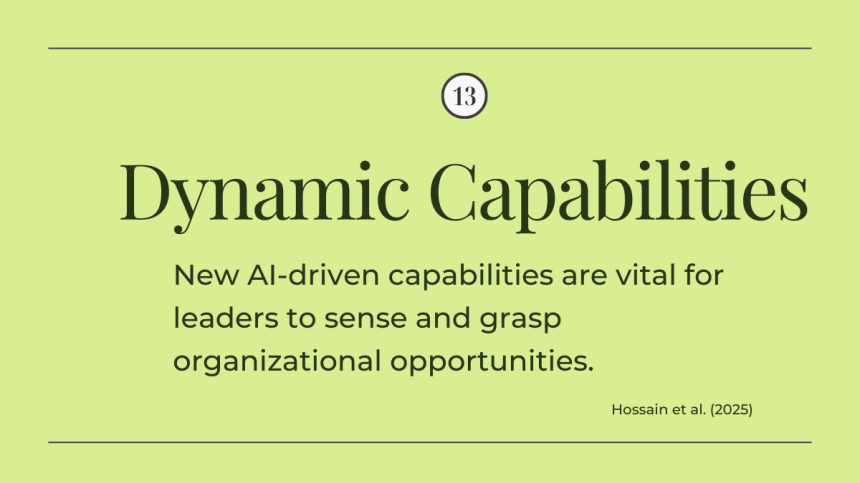
The necessary adaptive capability demands heightened human critical thinking, particularly the sense-making capability. Leaders must critically use this sense-making capacity to process complex AI insights, retaining the human capacity for judgment while informed by data-driven rationality. The critical goal is to “grasp the near and distant future objectives of AI initiatives” and communicate these insights effectively to keep employees confident, assuring them that advanced automation will not automatically jeopardize their jobs, ensuring a strategic and responsible organizational trajectory.
The authors, Sahadat Hossain, Mario Fernando, and Shahriar Akter, suggest that AI-driven capabilities and transformational leadership attributes are compatible and increasingly essential for successful digital leadership. What specific training interventions best cultivate the critical adaptive capacity needed to translate AI-based information into strategic organizational action? Let’s share ideas.
#Leadership #AIinBusiness #DynamicManagerialCapabilities #AdaptiveLeadership #CriticalThinking #DigitalLeadership #SenseMaking
Reference: Hossain, S., Fernando, M., & Akter, S. (2025). Digital Leadership: Towards a Dynamic Managerial Capability Perspective of Artificial Intelligence-Driven Leader Capabilities. Journal of Leadership & Organizational Studies, 32(2). https://doi.org/10.1177/15480518251319624

 Justin O'Brien