Tag Archives: AIinBusiness

19. The AI-Enabled Leadership Framework: Unifying Strategy, Ethics, and Human Judgment
The following is the conceptualisation of the research-based series exploring AI’s impact on leadership.

If AI is a strategic imperative, can leaders afford to treat ethics and data fluency as mere compliance checklist items? The ultimate challenge of the AI era is synthesis: bringing together disparate technical, ethical, and human demands into a coherent strategic model.

Flow chart detailing The AI-Enabled Leadership Framework Model, structured across three phases: Foundation (Blue), Action (Purple), and Sustainability (Green). The model identifies 14 strategic steps, starting with a Red Target icon for the core Vision and including areas like Governance, Ethics, Upskilling, and Feedback.
The complete strategic framework illustrating 14 steps for guiding leadership development and decision-making in AI-transformed organizations.

The “AI-Enabled Leadership Framework Model” achieves this synthesis by structurally integrating the critical requirements identified across contemporary leadership research into three interdependent sections. First, it establishes the Foundation by mandating Executive Data and AI Fluency and Governance, Risk & Guardrails. This addresses the strategic necessity of understanding ML essentials and generative architectures, enabling leaders to ask sharper questions about systems and data. Second, the AI-Enabled Leadership in Action section addresses the core behavioral shift, requiring Adaptive Leadership Traits and Ethical and Inclusive Decision-Making. This is the most critical function: ensuring human judgment balances utilitarian AI output with necessary human values. Third, the Sustainability and Continuous Growth section manages the long-term journey through Transformational Capability and Feedback Loops. This aligns with the Dynamic Managerial Capabilities (DMC) view, ensuring the organization can actively Pilot → Refine → Scale → Iterate to maintain competitive advantage in volatile environments. The framework functions as an integrated blueprint, transforming theoretical mandates into a practical roadmap for leading hybrid human–AI organizations.

This structural approach directly addresses the primary research gap: the fragmentation of literature across technical, behavioral, and ethical domains. It elevates critical thinking from an abstract concept to a structured, repeatable process embodied in the Ethical and Inclusive Decision-Making phase (Goal 9). This critical function serves as the essential mediator, putting automated decisions into real-world context through human judgment. Furthermore, by emphasizing Trust, Transparency, and Human Oversight (Goal 10), the model compels leaders to address the risks of algorithmic bias and ethical missteps, ensuring that the powerful “double-edged sword” of AI is wielded responsibly.

I would like to suggest that this framework provides a strategic roadmap for organizations to navigate the transformative potential of AI. How does your organization currently measure and reward leaders who successfully balance AI-driven efficiency with ethical mediation and human oversight? Let’s share approaches.

17. Multilevel Review of AI in Organizations

Part 17 of 17 of a research-based series exploring AI’s impact on leadership This post summarises the article A multilevel review of artificial intelligence in organizations: Implications for organizational behavior research and practice by Bankins et al. (2024)

Is the biggest challenge of AI implementation human resistance, or our failure to frame AI’s role correctly within the organizational psychological contract? The future of work depends not just on technology adoption, but on how human leaders manage the ensuing social and psychological shifts.

This multilevel literature review focuses specifically on the micro-level implications of AI for organizational behavior (OB), inductively classifying findings across individual, group, and organizational contexts. The study finds that successful Human–AI collaboration is fundamentally driven by employee attitudes, which are highly contingent on how they perceive AI’s capabilities compared to their own. Crucially, collaboration is significantly facilitated when employees feel both confident in and supported by the AI system. Conversely, when AI is perceived as a control mechanism (e.g., in the gig economy), workers may resort to “anticipatory compliance” or identity work for psychological relief. This highlights that the successful integration of AI requires intentional strategies to enhance job autonomy and innovative behaviors, rather than just increasing control or substitution.

The tension highlighted between AI’s capacity for objective management (e.g., in HR processes) and human perceptions of fairness demands acute critical thinking in the psychological design of work. The critical takeaway is that leadership must use strategic judgment to mitigate the risk of “algorithmic reductionism,” where fair outcomes are achieved at the expense of procedural justice perceptions. When AI decisions are perceived as unfair or lacking transparency, employee trust erodes. Therefore, critical thinking must be applied to determine how to positively frame AI’s contributions, while consciously structuring managerial practices (hiring, promotion) to ensure that the use of AI promotes genuine organizational fairness.

The authors, Sarah Bankins et al., suggest that future research must investigate how AI can be deployed to promote fairness in managerial practices such as hiring, promotion, and compensation decisions. How do you ensure your AI implementation strategy focuses on enhancing employee confidence rather than triggering anxiety over substitution?

Reference: Bankins, S., Ocampo, A. C., Marrone, M., Restubog, S. L. D., & Woo, S. E. (2024). A multilevel review of artificial intelligence in organizations: Implications for organizational behavior research and practice. Journal of Organizational Behavior, 45(2), 159–182. https://doi.org/10.1002/job.2735

16. AI-First Leader: Strategic Imperative

Part 16 of 17 of a research-based series exploring AI’s impact on leadership. This post summarises the article Excerpts from “AI-First Leader: A Practical Guide to Organizational AI Leadership” by Havash et al. (2025)

Is your boardroom ready for the AI-First operating model, or are you still viewing AI as merely a technical experiment? AI is no longer just a trend, it’s the engine driving modern digital transformation.

The core finding emphasizes that AI’s evolution has made it a strategic necessity for organizational relevance, moving it beyond a mere technical tool. Leaders must gain technical fluency and strategic perspective to lead AI initiatives with confidence, acquiring a practical foundation in Machine Learning (ML) essentials and understanding key governance principles. For business professionals, the demand is to bridge AI strategy with execution, leveraging actionable frameworks (like prompt design patterns and ROI storytelling) to drive automation and align technological capabilities with core business Key Performance Indicators (KPIs). Successful implementation allows for organizational scalability, empowering systems to handle exponentially higher workloads, and enables hyper-personalization for customers. Executives must lead transformation with clarity and conviction, mastering advanced techniques like Retrieval-Augmented Generation (RAG) and agentic workflows, and balancing rapid innovation with stringent governance requirements to build robust, production-ready systems.

The shift to an AI-First operating model fundamentally elevates the role of human critical thinking from tactical task execution to strategic synthesis and ethical governance. Leaders can no longer afford to delegate AI purely to IT teams; they must deploy sharp critical thought to ask sharper questions regarding ML concepts, data roles, and governance frameworks. The most critical application of human judgment lies in interpreting complex AI outputs and ensuring alignment with Responsible AI principles. This critical function is essential because the power of Generative AI is a “double-edged sword” that is “brimming with potential yet fraught with risk”. Critical thinking is necessary to avoid obsolescence and safeguard the organization against “ethical missteps, privacy violations, or security failures,” ensuring that technology serves strategic objectives, not the reverse.

The authors suggest that mastering ML essentials and integrating AI strategy with execution is paramount for the modern leader, providing a blueprint for the “AI-first leader”. Are you leading or merely reacting to AI adoption? What steps are you taking now to mitigate the inherent risks associated with this powerful, dual-natured technology?

Reference: Mehta, B., & Kumar, M. (2025). AI-First Leader : A Practical Guide to Organizational AI Leadership (1st ed.). CRC Press LLC. pp. 22-88

15. AI Capabilities and Responsible Leadership (Ethical Resonance)

Part 15 of 17 of a research-based series exploring AI’s impact on leadership This post summarises the article The influence of artificial intelligence-driven capabilities on responsible leadership: A future research agenda by Hossain et al. (2025)

How can leaders manage the disruptive force of AI while ensuring their decisions uphold ethical standards and social responsibility? This systematic review investigates the capabilities required to lead responsibly in AI-driven environments, finding organizational leaders require technical, adaptive, and transformational capabilities. A core concept introduced is ethical resonance—the capacity for moral judgment and systemic view when evaluating AI decisions—which AI-driven capabilities enhance. This is critical because AI decisions, often rooted in utilitarian approaches, may prioritize value creation over adherence to ethical standards. The goal is to enhance Responsible Leadership Performance (RLP) across effectiveness, ethics, and endurance.

The necessity for ethical resonance elevates critical thinking to a non-negotiable component of responsible leadership. Leaders must exercise critical judgment to bridge the gap between AI’s analytical competence and the necessary human warmth and moral foundations (deontological approach) that AI lacks. The critical imperative is the demand for a systemic view; leaders must critically evaluate AI’s impact from the perspective of multiple stakeholders, ensuring that AI systems adjust to people, rather than forcing people to adjust to the systems. This systemic critical appraisal helps leaders detect biases and monitor unethical behaviors to improve RLP.

The authors, Sahadat Hossain, Mario Fernando, and Shahriar Akter, suggest that AI-driven capability positively impacts leaders’ ethical resonance, which is crucial for developing AI strategies that ensure the societal greater good. What are the most effective strategies for developing a leader’s systemic view—the ability to critically balance AI efficiency with stakeholder consequences?

Reference: Hossain S, Fernando M, Akter S. The influence of artificial intelligence-driven capabilities on responsible leadership: A future research agenda. Journal of Management & Organization. 2025;31(5):2360-2384. doi:10.1017/jmo.2025.10010

14. The Now, New, and Next of Digital Leadership (AI Substitution)

Part 14 of 17 of a research-based series exploring AI’s impact on leadership This post summarises the article The Now, New, and Next of Digital Leadership: How Artificial Intelligence (AI) Will Take Over and Change Leadership as We Know It by Van Quaquebeke and Gerpott (2023)

Is human leadership romanticized? Algorithms are not just tools; they are poised to replace core human leadership functions, potentially performing them better. This commentary acts as a “wake-up call”, challenging the consensus that motivational and relational leadership is impervious to AI substitution. The framework details AI’s progression from a tool (NOW) to an advisor (NEW) to eventually full replacement (NEXT). The core finding suggests sophisticated algorithms can effectively embody core leadership characteristics, potentially catering better to employees’ psychological needs for autonomy, competence, and relatedness by offering immediate, data-driven, and unbiased feedback. For instance, AI can facilitate social connections by identifying optimal team pairings.

This argument for imminent substitution demands a radical reassessment of leadership scholarship, making critical thinking the key to retaining human control and relevance. Leaders must deploy critical thought to model ethical trade-offs. This means moving beyond simplistic performance outcomes to anticipate complex scenarios, such as when AI might encourage abusive leadership behaviors for the sake of short-term benefits, even if it leads to human suffering. Furthermore, leadership scholars must critically engage with the technical fundamentals of AI to avoid becoming overdependent on technology, risking underdeveloped reasoning capabilities.

The authors, Niels Van Quaquebeke and Fabiola H. Gerpott, suggest that the field risks sleepwalking into an unexamined reality and failing to adjust in time if it does not address the topic of AI substitution candidly. If AI can deliver better motivational outcomes, what is the fundamental moral duty of a human leader who chooses to reject algorithmic advice? Let’s debate.

Reference: Van Quaquebeke, N., & Gerpott, F. H. (2023). The Now, New, and Next of Digital Leadership: How Artificial Intelligence (AI) Will Take Over and Change Leadership as We Know It. Journal of Leadership & Organizational Studies, 30(3), 265–275. https://doi.org/10.1177/15480518231181731

13. Digital Leadership: Dynamic Managerial Capability Perspective

Part 13 of 17 of a research-based series exploring AI’s impact on leadership This post summarises the article Digital Leadership: Towards a Dynamic Managerial Capability Perspective of Artificial Intelligence-Driven Leader Capabilities by Hossain et al. (2025)

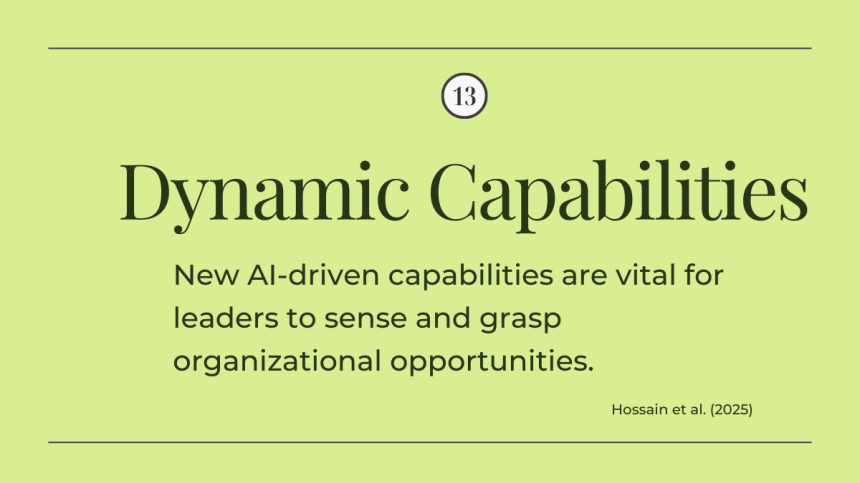
Are traditional managerial capabilities obsolete, or are they simply being amplified and redefined by AI? This research, viewing AI-driven capabilities through the Dynamic Managerial Capabilities (DMC) lens, finds that digital leaders require technical, adaptive, and transformational capabilities to succeed in AI environments. The key finding is that AI-driven capability enhances human intelligence by stimulating reasoning and enabling collaborative human-machine behavior, thereby overcoming cognitive limitations. Specifically, transformational leaders are well-positioned to operationalize these capabilities, fostering creativity, adaptability, and managing employee fears about job security.

The necessary adaptive capability demands heightened human critical thinking, particularly the sense-making capability. Leaders must critically use this sense-making capacity to process complex AI insights, retaining the human capacity for judgment while informed by data-driven rationality. The critical goal is to “grasp the near and distant future objectives of AI initiatives” and communicate these insights effectively to keep employees confident, assuring them that advanced automation will not automatically jeopardize their jobs, ensuring a strategic and responsible organizational trajectory.

The authors, Sahadat Hossain, Mario Fernando, and Shahriar Akter, suggest that AI-driven capabilities and transformational leadership attributes are compatible and increasingly essential for successful digital leadership. What specific training interventions best cultivate the critical adaptive capacity needed to translate AI-based information into strategic organizational action? Let’s share ideas.

Reference: Hossain, S., Fernando, M., & Akter, S. (2025). Digital Leadership: Towards a Dynamic Managerial Capability Perspective of Artificial Intelligence-Driven Leader Capabilities. Journal of Leadership & Organizational Studies, 32(2). https://doi.org/10.1177/15480518251319624

12. Transformational Leadership, AI Competitiveness, and Project Performance

Part 12 of 17 of a research-based series exploring AI’s impact on leadership This post summarises the article Transformational Leadership, AI Competitiveness, and Project Performance: A Moderation Analysis by Ofosu-Ampong and Adu-Ntim (2025)

Does implementing highly automated AI processes inevitably lead to a loss of human leadership effectiveness and organizational oversight? This study investigated how leadership styles interact with AI competitiveness in multinational organizations, finding that while transformational leadership positively enhances the benefits of AI integration (scope and frequency of use), excessive AI-enabled process automation shows a negative effect on project performance. This research challenges the conventional assumption that greater technology acceptance automatically equates to higher productivity, noting that AI satisfaction did not significantly influence project performance when leadership oversight is lost due to over-automation. This emphasizes the critical need for a precise balance between AI-enabled processes and crucial human elements.

The negative correlation between excessive automation and diminished performance establishes a clear role for critical boundary management. Leaders must use critical thought to precisely determine where substitution ends and human augmentation begins. The key critical function for transformational leaders is managing the human–AI interaction to prevent automation saturation from compromising essential human oversight and strategic flexibility. This demands continuous critical evaluation of the trade-off: specifically, analyzing the “mechanisms through which transformational leadership behaviors directly impact AI-related outcomes” to maximize system benefits while maintaining appropriate levels of process automation.

The authors, Kingsley Ofosu-Ampong and Julius Adu-Ntim, suggest that organizations must develop leadership approaches that effectively promote AI usage while maintaining appropriate levels of process automation to maximize AI system benefits. What metric should leaders use to determine if they have crossed the threshold into ‘excessive automation’ that risks diminishing their human leadership effectiveness? Share your view.

Reference: Ofosu-Ampong, K., & Adu-Ntim, J. (2025). Transformational Leadership, AI Competitiveness, and Project Performance: A Moderation Analysis. International Journal of Global Business and Competitiveness. https://doi.org/10.1007/s42943-025-00124-x

11. The Future of Leadership in the Context of AI and Automation

Part 11 of 17 of a research-based series exploring AI’s impact on leadership This post summarises the article The Future of Leadership in the Context of Artificial Intelligence and Automation: Navigating Ethical and Operational Challenges by Khoza et al. (2025)

As AI tools take over decision-making, are leaders becoming irrelevant, or are they gaining unprecedented strategic power? This study emphasizes the dual mandate for leaders: to strategically leverage AI for efficiency while diligently addressing ethical dilemmas, particularly algorithmic bias, data privacy, and the risk of diminished human qualities. The key finding highlights that effective leadership requires a specialized set of competencies, notably adaptability, data literacy, emotional intelligence, strategic thinking, and a strong ethical foundation. AI-driven tools, such as machine learning and virtual reality, can revolutionize leadership development by providing personalized, real-time feedback and scenario-based training. However, preserving human-centric practices—like trust-building and collaboration—is paramount to ensure AI doesn’t undermine the human element.

The necessity for data literacy essentially redefines the core function of critical thinking for the modern leader. Critical thinking must shift toward rigorously interpreting and acting upon AI-generated insights, ensuring that these data-driven actions align with human ethical standards. The core critical challenge is navigating the complex power structures that emerge when technological accuracy challenges positional authority, ensuring that technological reliance does not lead to the erosion of personal power or the neglect of ethical issues like bias and privacy.

The authors, Nomfundo Zama Khoza, Kenneth Chukwuba, Ebuka Emmanuel Aniebonam, and Lois Dufie Adade, suggest that recommendations emphasize the need for AI ethics training, inclusive leadership practices, and a human-centric approach to AI integration. How do you train for data literacy and emotional intelligence simultaneously, ensuring AI serves human leadership instead of replacing it? Join the conversation.

Reference: Khoza, N. Z., Chukwuba, K., Aniebonam, E. E., & Adade, L. D. (2025). The Future of Leadership in the Context of Artificial Intelligence and Automation: Navigating Ethical and Operational Challenges. British Journal of Business and Psychology Research, 1(1), 52–62. https://doi.org/10.47297/ppibjbpr2025010104

10. The Impact of AI on Evolving Leadership Theories

Part 10 of 17 of a research-based series exploring AI’s impact on leadership This post summarises the article The Impact of AI on Evolving Leadership Theories and Practices by Frimpong (2025)

Can leadership remain fundamentally “human” when data-driven AI challenges the traditional reliance on intuition, experience, and emotional perception? This paper argues that the rise of AI compels leadership theories to evolve, necessitating the development of hybrid leadership models that fuse AI’s analytical strengths with indispensable human qualities like empathy and ethical judgment. The core finding highlights that AI enhances leadership effectiveness by automating routine tasks, optimizing workforce performance, and providing valuable data-driven insights. However, this shift introduces critical risks, including algorithmic bias, a lack of transparency, and the potential erosion of human-centric attributes like emotional intelligence.

The emergence of this hybrid model places critical thinking at the core of human responsibility, transforming it into a necessary ethical safeguard. Leaders must critically interpret AI’s analytical insights within complex organizational and ethical contexts. The crucial takeaway is the need for human leaders to scrutinize the algorithms themselves, ensuring they reflect ethical frameworks, are fair, and are accountable, actively preventing the perpetuation of biases embedded in training data. This critical oversight ensures that the efficiencies gained do not diminish the foundational human attributes of trust and compassion.

The author, Victor Frimpong, suggests that integrating AI into leadership must be conducted with caution and responsibility, safeguarding fundamental human attributes like ethical decision-making. How can we ensure that “hybrid leadership” means augmentation of human judgment, not merely automation of human ethical responsibility? Join the debate.

Reference: Frimpong, V. (2025). The Impact of AI on Evolving Leadership Theories and Practices. Journal of Management and Work, 2024(4), 400–417. https://doi.org/10.53935/jomw.v2024i4.1100

9. Leadership Training in the Age of AI

Part 9 of 17 of a research-based series exploring AI’s impact on leadership This post summarises the article Leadership training and development in the age of artificial intelligence by Sposato (2024)

In the fast-evolving AI landscape, is the biggest challenge redesigning business processes, or redesigning the leader? This article highlights the critical imperative for leaders to adapt and commit to continuous learning, emphasizing the necessity of updating leadership training in the AI era. The core finding suggests that as AI automates regulatory and transient data-driven tasks, the next generation of managers must shift their focus to higher-level liabilities. These include fostering innovative thinking, creative problem-solving, and concentrating on strategic employee development. This redirection requires directors and leaders to understand the technical roles of AI and intentionally fill the human gaps left by automation, transitioning effectively to a data-centric decision-making approach.

This evolution makes sustained critical thinking synonymous with future leadership viability, specifically demanding the cultivation of a culture of continuous learning. Leaders must use critical judgment to invest in technologies that genuinely streamline operations, freeing them up to focus on strategic planning and innovation, rather than simply replacing tasks. The “so what” for critical thinking is that it ensures leaders assume the role of guardians of powerful machines, continuously questioning and adapting their skill set, and resisting the urge to rely on AI without contextual validation.

The author, M. Sposato, implicitly suggests that whether leaders are born or made, structured development is needed to address the challenges of staff shortages and technological change. What elements of traditional leadership training must be unlearned immediately to cultivate the critical, adaptive mindset required by the AI era? Share your opinion.

Reference: Sposato, M. (2024). Leadership training and development in the age of artificial intelligence. Development and Learning in Organizations: An International Journal, 38(4), 4–7.

« Older Entries