
Category Archives: Stage Fright

8 Powerful Strategies to Overcome Public Speaking Anxiety

Public speaking anxiety is a common challenge that affects even seasoned professionals. The thought of standing before an audience can trigger nerves, self-doubt, and panic. However, public speaking is a skill that can be learned and mastered with the right techniques.

In this post, we’ll explore eight powerful strategies to overcome public speaking anxiety and empower your voice. By implementing these tactics, you’ll be able to confidently address any audience and deliver impactful presentations.

Understanding the Roots of Public Speaking Anxiety

Public speaking anxiety often stems from a fear of negative judgment. This fear can make you overly self-conscious, focusing on every perceived flaw in your delivery. Past experiences, like embarrassing moments or harsh criticism, can fuel this anxiety. Additionally, a lack of confidence in your speaking abilities can create a vicious cycle of self-doubt and nervousness. Biological factors, like a heightened stress response, can also make some individuals more susceptible to intense physical and emotional symptoms during public speaking situations.

8 Strategies to Conquer Your Fear

  1. Deep Breathing for Instant Calm

When anxiety hits, take slow, deep breaths from your diaphragm. Breathe in for 4 seconds hold for 4 seconds and breath out for 4 seconds, repeat this cycle for 5-10 minutes. This technique slows your heart rate, increases oxygen flow to your brain, and promotes a sense of calm.

Psychological Principle: Deep breathing activates the parasympathetic nervous system, which counteracts the “fight or flight” response triggered by anxiety.

Case Study: Sarah, a marketing executive, used deep breathing exercises before every product launch presentation. She reported feeling significantly calmer and more focused, leading to a pitch perfect presentation.

  1. Meditation: Cultivate Inner Peace

Regular meditation practice can improve focus and clarity during your speech, allowing you to connect more effectively with your audience.

Psychological Principle: Meditation enhances emotional regulation by strengthening the prefrontal cortex, which helps manage stress responses.

Exercise: Try a 10-minute guided meditation specifically designed for public speaking anxiety. Focus on visualizing a successful presentation and cultivating a sense of calm confidence.

  1. Mindfulness and Breathwork

Mindfulness, the practice of being fully present in the moment, can significantly reduce stress and anxiety. Integrating mindfulness and controlled breathing into your daily routine enhances emotional regulation and builds resilience to stress.

Psychological Principle: Mindfulness practices have been shown to reduce activity in the amygdala, the brain’s fear center, while increasing activity in areas associated with emotional control.

  1. Craft a Winning Speech Structure

Think of your speech as a three-act play:

  • Act 1: Start Strong – Welcome your audience, grab their attention with a hook, and set the stage with a clear agenda.
  • Act 2: Engage and Inform – Weave together persuasive arguments and informative details. Use examples and stories to make your points memorable.
  • Act 3: Leave a Lasting Impression – Summarize key takeaways, deliver a call to action, and say thankyou.

Scenario-Specific Tip: For impromptu speeches, quickly jot down 3 main points you want to cover. This structure will help you stay focused and organized even with minimal preparation time.

  1. Simulate Real-Life Scenarios

Practice makes perfect! Rehearse your speech in various settings to build confidence and adaptability.

Exercise: Join a public speaking group or use virtual reality technology to practice in simulated environments. Record yourself and review the footage to identify areas for improvement.

Success Story: Tom, a software engineer, used VR simulations to prepare for his first conference talk. The immersive practice helped him feel more at ease with large audiences, resulting in a well-received presentation.

  1. Visualize Success

Imagine yourself delivering a successful speech to a receptive audience. Visualize positive audience reactions and smoothly handling unexpected hiccups.

Psychological Principle: Visualization activates the same neural pathways as actually performing the task, priming your brain for success.

Exercise: Spend 5 minutes each day visualizing your upcoming presentation. Engage all your senses – what do you see, hear, and feel as you deliver a confident, impactful speech?

  1. Harness the Power of Visual Cues

Incorporate visual aids like images or keywords to maintain focus and reduce anxiety during your presentation. Pay attention to positive audience reactions to create a supportive atmosphere.

Scenario-Specific Tip: For virtual presentations, use digital cue cards or sticky notes placed near your camera to keep key points in view without losing eye contact with your audience.

  1. Structured Practice and Preparation

Confidence comes from feeling prepared. Rehearse your speech systematically, utilizing a detailed outline or script to ensure you cover all key points and maintain a logical flow.

Goal-Setting Exercise: Set SMART goals for your presentation practice:

  • Specific: “I will practice my full speech 3 times per week.”
  • Measurable: “I’ll reduce my use of filler words by 50%.”
  • Achievable: “I’ll memorize my opening and closing paragraphs.”
  • Relevant: “I’ll research and incorporate 2 relevant case studies.”
  • Time-bound: “I’ll have my final draft ready 1 week before the presentation.”

Measuring Progress

To track your improvement:

  1. Use a anxiety scale (1-10) before and after each practice session.
  2. Ask for specific feedback from trusted colleagues or mentors.
  3. Record your speeches and note improvements in body language, voice tone, and content delivery.
  4. Set small, achievable goals for each presentation and celebrate your progress.

Remember, overcoming public speaking anxiety is a journey, not a destination. Be patient with yourself and celebrate each step forward. With consistent practice and application of these strategies, you’ll develop the skills and confidence to deliver powerful presentations in any scenario.

By mastering public speaking, you’re not just conquering a fear – you’re unlocking a powerful tool for personal and professional growth. Your voice has the power to inform, inspire, and influence. Embrace the challenge, and let your message shine.
How Not to Choke Under Pressure – Public Speaking

Missfire #1 #2 #3 KaBOOM!

Conquering the fear of public speaking from Scatterbrain by Henning Beck.

The perfect storm of presentation poor performance presents itself when

#1 we focus on every single step making the very thing we don’t want to do top of mind,

#2 worrying so much about non-performance that we forget why we are there and

#3 letting our emotions run riot to the extent we would rather be dead.

And don’t forget we are doing all this under the watchful eye of an audience who are distracting our brains further!

So what can we do?

We need to realise that our brains stress response is doing exactly what we want it do.  It’s just that sometimes we are either pumping too much fuel into the engine or not enough, which results in under performance. It’s this realisation that is important.

The next thing we can do is practice under pressure.  So if we are rehearsing, rehearse without stopping – just keep going, errors included. Think about it, if you are presenting in front of an audience you cant just say “sorry I made a mistake I need to go back to the beginning”

Don’t learn your presentation word for word. If you miss out a phrase or a word you may become distracted and send your presentation into an abyss. Instead break your presentation down into main messages or key phrases and then link them together.  It’s much more interesting for you and your audience.

If your fear is failing in front of an audience, then Henning Beck suggests “you should try to visualise the pressure situation  as intensively as possible before it takes place….You should then play out the various scenarios in your mind in order to break down your fear of them”

One last helpful point Henning makes is not to cover up mistakes. If you lose your way, let the audience know, regain your place by checking your notes and then continue. For example, say “I may have jumped an important point let me just check my notes” or “I’ve gotten off track a bit, let me just see where I am”.

In addressing the fear of public speaking we need not only strategies for developing, designing and delivering our presentation,  just as importantly we need strategies for when our brain misfires!

How Not to Choke Under Pressure #3

Mental misfire #3 “The Over Excitement Trap” from Scatterbrain by Henning Beck.

Most of us have felt this over excitement at some stage of our careers – typically when giving a presentation. Here our autonomic nervous system is getting our body ready for the fight, flight or freeze response and pumping a cocktail of chemicals through our body including adrenaline.

But what causes our body to respond in this way? Henning Beck suggest that it’s the thought of either punishment or reward that contributes to this response. The reward might be winning an account or pitch and interestingly the higher the stakes the higher the error rate. Beck goes on to say “one of the most violent forms of punishment is social rejection.”  People are afraid of what others might say.

There are two things we can do here.

First, realise that this excitement or pressure is a good thing – it’s getting us ready to perform. Hans Selye said “it’s not stress that kills us, it is our reaction to it.”  Likewise Susan David says in her book Emotional Agility, “We own our emotions, they don’t own us.” So we need to turn the table on this over excitement and realise we can mange it.

However as Beck notes “too little pressure and we perform just as poorly as when the pressure increases tenfold.” So rather than trying to rid ourselves of the excitement all together just pare it back enough so that we are more focused. 

One way we can pare it back is to practice paced breathing. If you don’t already, practice paced breathing everyday and before your event. Paced breathing is simply gently breath in on a count of 4, hold for 4, breath out for 4 and repeat for 5 or 10 minutes.

The effect of this breathing is it will balance the autonomic nervous system, so we can become more focused and alert and less over excited!

How Not to Choke Under Pressure #2

Mental misfire #2 The Distraction Trap from Scatterbrain by Henning Beck.

Whilst a small amount of distraction is important to help engage the subconscious in a step by step process, such as in sport when you are kicking for goal, this doesn’t work so well when we are undertaking complex tasks such as an exam, test or interview.  Here we need all the brains energy to focus on the task at hand and any anxiety we experience robs us of that energy.

Beck suggests we “combat the anxiety directly by simulating the pressure situation in practice, thus growing accustomed to it.”

For example in an interview rehearsal you create the pressure by allowing yourself only one attempt at an answer. The key however, is to make sure you are observed, that you have one or a couple of people play the role of the interviewer. This observation is incredibly distracting and creates the pressure we need in a safe environment.

So going over and over something doesn’t help as much as rehearsing under pressure.

How Not to Choke Under Pressure #1

I’ve just started reading Scatterbrain by Henning Beck, and in his chapter called Blackout he offers a number of strategies for helping us to avoid “choking under pressure”. He calls them Mental Misfires and here’s the first one:

Mental misfire #1: the step-by-step trap.

When we rehearse something over and over and imbed that process into our subconscious why is that when we go to perform we mess-up?

It has to do with our observant and operative systems of action. Our operative system embeds the process and our observant system scans the environment for obstacles. When we are about to perform the observant system starts looking for things that can go wrong – so guess where our focus goes? To help this to not occur Beck suggest the following:

“If you find yourself concentrating too much and thereby tensing up under pressure, it might therefore be wise to try distracting yourself a little with something else. Pause and look out the window briefly, let your thoughts drift to something else, recall a pleasant memory, play it through and linger for a few seconds and then, as you turn back, don’t concentrate on your task deliberately but simply act. Just as my athletics coach always said to me: ‘Henning, you think too much.’ Such a criticism is offered far too seldom in the modern world.”

Beck, H 2019, Scatterbrain : How the Mind’s Mistakes Make Humans Creative, Innovative and Successful, Sydney : NewSouth Publishing.

Image: Rawpixel

Dealing with nerves

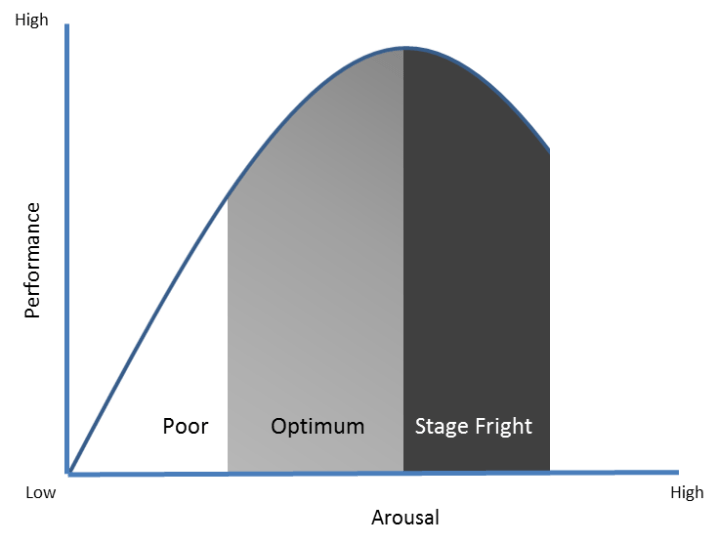
Feeling nervous is a good thing (just not too nervous) have a look at the chart below.

The Yerkes-Dodson (xi) law demonstrates an empirical relationship between arousal and performance. It dictates that performance increases with cognitive arousal, but only to a certain point: when levels of arousal become too high, performance will decrease.

When you present, you want to be in the grey zone, here your arousal or adrenalin is at the right level.  If you substitute the word arousal for fear you can conclude that a certain amount of fear is a good thing – too much is what we call stage fright where you stutter, stumble and sweat your way through a presentation.  So if you suffer from stage fight the trick is not to eradicate what you are feeling but to “knock the edge off” so you move into the grey zone.  Think of it like an athlete – if they are not pumped before going onto the field (in the grey zone) they won’t perform at their peak.  Too much adrenaline and they could perform poorly.  Listed on the next page are some techniques for “knocking the edge off”.

Ted Schredd has written a great article on the physiological similarities between fear and excitement, I’ve captured a piece of great advice here:

Most of your fears are imagined and should be treated as imaginary. Learn to distinguish the fears that are valid and those that are not. The next time you feel scared, challenge your fear and the thing you fear will disappear. Ask yourself, “What would I do if I wasn’t feeling fear?” then act accordingly. When you confront your fears, astonishing things will happen. Remember you are the master and you are in control.

The second thing I want to talk about is the importance of content and delivery.  Many presenters put undue pressure on themselves because they believe they don’t deliver well and as a consequence build up unbelievable levels of anxiety.  Remember if you get your content right using a solid strategy (like the one I’m taking you through here) the delivery will start to take care of itself.  You will come across as being confident, authentic and believable – your audience will sense this and will complement you accordingly. I’m not saying that delivery is not important; you just have to get the order right – content first then work on your delivery.

Some communication consultants site studies such as Albert Mehrabian’s work which states that the meaning of a message is communicated by:

Your words 7%
Your tone of voice 38%
Your body language 55%.

They then use this information to tell you that delivery is the only thing that matters.  In fact as Olivia Mitchell explains in Mehrabian has been miss quoted.  I would go as far as to say that to apply this rule in a business context is just plain wrong. The message here is don’t put undue pressure on yourself to deliver like your favourite business leader when it’s not necessary.

My top tips for reducing the effect of nerves and “knocking the edge off” are:

– Know your material inside out and try never to deliver someone else’s presentation unless you know the subject matter intimately. Know your environment; for example does all the equipment work? How much space do you have? Know your audience: even if you are at a conference mingle with the audience beforehand. Know yourself and be yourself; know what you are capable of, what you are not.and be the best you can be.

– Rehearse, rehearse, rehearse; as often as you can where ever you can. Get a measure on your performance, look after your personal branding (xiii), and get honest feedback on what you can work on next time.

– Meditate, swim run work out; some people manage their nerves by undertaking some form of exercise. Don’t drop off your regular exercise routine. Don’t change your diet; eat well and don’t skip meals or drop off your fluids

– Breathe – this is potentially the most effective exercise you can use to calm your nerves. The exercise goes like this: start by exhaling all the air from your lungs (don’t breathe in first), then breathe in for 5 seconds, hold for 5 seconds and exhale for 5 seconds. Repeat this 4 times.  Do this on a regular basis, before the nerves kick in and prior to presenting.

Give yourself a break everyone makes mistakes – have a look at Steve Jobs bloopers

Be authentic in your delivery

There are two types of presentations; Presentations that are made to large groups of people that you see CEO’s, politicians and VIP’s give – when done well, these are the ones you typically and unfairly think you need to emulate.

The second type is the one you give every day to colleagues, clients and at social gatherings. In these situations don’t feel you have to present like your favourite politician. You have to present the best you can and your style of delivery will depend on 4 things

Subject: what you are there to talk about.
Occasion: is a product launch, conference or birthday speech.
Audience: think about their expectations, communication styles, motivations and titles.
Your Personality: don’t try and be someone you are not, just be the best you can be.

Why is delivery important?
If you want to effectively communicate with your audience, to influence, persuade or just create a good impression, you need to adapt your delivery style to match the expectations and communication needs of your audience

This is about increasing the size of your delivery skill toolbox, so you can use the right tool for the job.  This takes work and practice but the good news is your tool box is different to everyone else’s.  So your version of dynamic voice will be different to everyone else’s, and your version of serious is also different to everyone else’s. But here’s the thing, the audience knows if you are faking.  So have a look at the eight behaviours listed below and ask yourself what you need to work on.

Once that’s established just focus on that element. Watch videos of people who do it well, try and emulate that facet and make it your own.  Please note that I’m not saying copy other people, but observe them and learn and see how you can incorporate that element into your style. This may be such things as noticing how a presenter may smile a lot or pause or emphasise with a subtle gesture.

Eight Behaviours

1. Facial expression
Smiling is a powerful cue that transmits friendliness, warmth, and approachability.  Smiling is often contagious and others will react favourably.  They will be more comfortable around you and more open to the information you are offering.

2. Eye contact
Steady eye contact helps to regulate the flow of communication, encourages participation, and can be used to develop rapport with the audience.  When the audience feels that you see them as individuals, they are more likely to trust you and be more open to your recommendations.

Some tips for using eye contact to build rapport include

– Length of Eye Contact: Try to maintain eye contact with one person at a time for at least 2-3 seconds. This helps to establish a connection with people and helps you to avoid darting eyes, which can be distracting and communicate nervousness.
– Movement of Eyes:  Direct eye contact towards different parts of the audience throughout the course of your presentation.  Staring too long in one direction may cause you to miss important information and can make certain audience members feel less important.
– Search for Friendly Eyes: If you are nervous, look for a friendly audience member and establish eye contact with that person.  Gradually, work to establish eye contact with everyone.

Some habits to avoid include:

– Talking to the Ceiling: Don’t present to a spot over the tops of the audience’s heads.  They may think you don’t care or they may feel that you are “above them.”
– Talking to the Screen: Don’t speak to your notes, to the whiteboard, or to your visuals.  The audience may not be able to hear you and may become disinterested.
– Clutching Your Notes: Be familiar with your material.  Being tied to your notes or a manual keeps you from establishing eye contact and may cause the audience to question your knowledge, preparedness, and confidence.

When presenting to groups you need to have stronger eye contact than usual.  Have you ever been to a concert and thought the performer was looking directly at you?  Maybe they were, maybe not – either way they were using a technique called clustering.  In this technique you group the audience into clusters.  If you have a large audience your clusters are very small in the first row – one or two people and the cluster becomes bigger the further you go back. If it’s a very large audience then the clusters may be as big as twenty people toward the back

Now target an individual in each cluster, and hold eye contact with that person as you deliver a thought or idea.  When focusing on the clusters at the front of the room hold for a duration of 4 -5 seconds and when focusing on clusters at the back hold for up to 10 seconds.  Move randomly amongst the clusters.  This gives the impression that you are looking at everyone in the cluster.

4. Posture
You communicate numerous messages by the way you hold yourself while presenting.  A person who is slouching or leaning with arms across their chest may be perceived as being uninterested or unapproachable.  Standing erect, facing the audience with an open stance, and leaning forward communicates that you are receptive and friendly.  Speaking with your back turned or looking at the floor or ceiling should be avoided as it communicates disinterest.

5. Body movement
Moving naturally around a room or stage increases interaction, adds interest, and draws attention to the presentation.  Staying frozen in the front of the room can be distracting and boring for people to watch.  Shuffling feet and pacing can convey nervousness and lack of confidence.

6. Gestures
A lively speaking style captures attention, makes the material more interesting, and facilitates understanding.  Use natural movements to emphasize topics and free, easy arm and hand movements to add personality to your presentation.  If you fail to gesture while speaking, you may be perceived as boring and stiff.  Gesturing too often can also be distracting for some audiences.

7. Proximity
Cultural norms dictate a comfortable distance for interaction with others.  When interacting, a presenter needs to be aware of people’s defined levels of personal space.  Signals of discomfort caused by invading other’s space may include rocking, leg swinging, tapping, and gaze aversion.  Do not invade an audience member’s intimate space.  Most adults will feel uncomfortable, even if rapport has been established.

8. Voice
Voice is another area of communication that can affect the quality of audience retention.  An interesting and audible voice will be engaging, while a soft or monotone voice can cause boredom or disinterest among participants.  While it may be difficult to listen to and change your own voice, with awareness and practice, it is possible to use one’s voice effectively.  The first step to refining your voice is to understand the components of voice and identify common voice problems.  Once identified, most voice problems can be improved by being aware of the problem, altering some habits, and practicing new behaviors on a regular basis.

Pace
Pace is how long a sound lasts.  Talking too fast causes words and syllables to be short while talking slowly lengthens them.  Varying pace helps to maintain the audience’s interest. If you are continuously talking too fast or too slow:•be aware of your normal conversational pace and keep in mind how tension affects the speed in which you talk, •use breathing and natural pauses to slow down your pace, constantly vary your pace in order to maintain audience interest.

Projection
Projection is directing the voice so that it can be plainly heard at a distance.  Problems with projection are often the result of tension, breathiness, and breathing from your throat. Try to avoid projecting from your throat which can lead to sore throats, coughing, and loss of your voice. Take slow, deep breaths, initiated from your abdomen.  Open your mouth fully and speak to the people in the back of the room.

Articulation
Articulation is the ability to pronounce words distinctly.  It often reflects your attitude towards the words you are speaking.  Clear enunciation reflects self-confidence and interest, while slurred or mumbled speech, indicate insecurity or indifference. To remedy this speak at a slower pace than your normal conversational tone, take the time to pronounce each letter or sound within a word. and listen for common articulation problems, such as dropping the “g” at the end of words such as finding or going.

Pitch
Pitch is the normal range of the voice – its highness or lowness.  Think Pee Wee Herman for high and James Earl Jones for low.  Everyone is capable of a wide voice range.  Stress and poor breathing can greatly alter the pitch of your voice. Try to adjust your pitch to convey different meanings throughout a presentation. To alter pitch, control your breathing; breathe from your abdomen and slow your rate of speech, take pauses to relax between pitch changes

Inflection
Inflection is the manner in which pitch varies as you speak.  Inflection serves as verbal punctuation and involves changing pitch to convey meaning.  Upward inflections ask a question, suggest uncertainty or doubt, and communicate hesitancy.  Downward inflections give information and convey strength and authority to the audience.

Use upward and downward inflections appropriately. Avoid constant middle inflection where the voice neither rises nor falls but just drones on and on.It may help to think of these seven things as a graphic equaliser – there’s one on page 37. Each event, meeting or interaction you have has a different setting and combination.  So if you have only one setting, every presentation better be exactly the same.

Have a look at these presenters and identify what you like about their style – they are different but they are all passionate.

Helen Fisher: The brain in love
Siegfried Woldhek shows how he found the true face of Leonardo
Aimee Mullins: It’s not fair having 12 pairs of legs

Physical Activity, Mindfulness Meditation, or Heart Rate Variability Biofeedback for Stress Reduction

In their recent” study  (van der Zwan et al. 2015) found that

“…physical activity, mindfulness meditation, and heart rate variability biofeedback can all play a positive role in the reduction of stress and stress-related symptoms when carried out in a self-directed way. Since greater compliance is often associated with better results, the best intervention for someone may be the intervention that one finds easiest to commit to. An advantage of these self-help interventions is that they provide easily accessible help for people with stress complaints.”

There are a lot of resources to help us exercise and practice mindful meditation.   HRV biofeedback can be achieved by downloading any number of apps and can cost anywhere from $12.00 to $380.00, as well as using your Apple watch.

In order to get ourselves practicing these body hacks we need a bit of discipline. Pat Framer  the Australian Ultra Marathon Runner gives us his top five tips in achieving your goal or personal best (Chander 2016):

  1. Have a purpose – what you’re working towards
  2. Work out your timing put times and dates to everything and keep yourself accountable
  3. Work on all the support mechanisms – make sure your diet and lifestyle are in good shape
  4. Give yourself the best opportunity to be the best – make sure you have all the gear, running gear, a place to meditate or a biofeedback device.
  5. Let your family and friends know – don’t do it on your own

So set an early NY resolution to reduce your stress!

CHANDER, C 2016, Five simple ways to beat your PB, @newscomauHQ, viewed 17 Dec, <https://www.news.com.au/feature/special-features/five-simple-ways-to-beat-your-pb/news-story/54b1e58422eb68f52c217bf4c581b89d>.

van der Zwan, JE, de Vente, W, Huizink, AC, Bögels, SM & de Bruin, EI 2015, ‘Physical Activity, Mindfulness Meditation, or Heart Rate Variability Biofeedback for Stress Reduction: A Randomized Controlled Trial’, Applied Psychophysiology and Biofeedback, vol. 40, no. 4, December 01, pp. 257-268.

Remote Measurement of Stress via Heart Rate Variability

Whether you are working in transport, operating machinery, programming in cyber security, trading securities, working in essential services or landing the InSight rover on Mars, lapses in concentration can be costly. Daniel McDuff (et al. 2014) conducted research into how our stress can be measured using a camera that captured  heart rate, breath rate and heart rate variability. It was breath rate and heart rate variability that gave accurate measures of stress.

Even though this was conducted in a laboratory situation the potential applications are vast. Anywhere a camera can be mounted, feedback can be received and actions put in place to ensure the best possible decisions are made at a given point in time.

This could be done locally or remotely. For example, a currency trader could receive instant feedback that there is an increased probability that they are likely to make errors and need to take a break for 5 minutes and undertake focused breathing to bring their system back into balance.

Remote feedback can be collected and evaluated from across a room or across a country. For example, a fleet of ambulance drivers could be simultaneously monitored to ascertain whether they have recovered sufficiently from attending a distressing call before being allocated to the next job.

This can all be done currently by using Bluetooth or a wired solution affixed to the person.  However the use of cameras will enable data to be collected and actioned upon much more efficiently, effectively and over longer periods of time.

McDuff, D, Gontarek, S & Picard, R 2014, ‘Remote measurement of cognitive stress via heart rate variability’, Conf Proc IEEE Eng Med Biol Soc, vol. 2014, pp. 2957-60.

« Older Entries